15:00
tap anywhere to hide the time
A silent sitting timer. A bell to begin, a bell to end, a place to sit between them. It keeps your record here and, if you ask, in the cloud. It will never notify you, badge you, or ask you to come back. That is the whole app.
The rest is the world it comes from. It is six short pieces, and they are the reason the app looks and behaves the way it does.
In Grant Morrison's comic The Invisibles there is a satellite hidden on the dark side of the moon. It is round and pale with a red core, it is alive, and it is on your side. Its name is Barbelith.
The comic never explains it like a machine. It explains it like an organ: Barbelith is a placenta. A placenta connects an unborn child to a life it cannot see and cannot imagine, and feeds it until it is ready to be born. In the story, our whole world is the womb. Space and time are the walls of it. Barbelith is the organ that connects what is in here to what is out there, waiting for us to be ready.
Morrison did not invent it as a plot device. The name arrived in a dream, at about twenty one, alongside a first run of structured magical work and what Morrison has since called a minor nervous breakdown. Years later, on a rooftop in Kathmandu, something happened that took the whole comic to explain: the universe seen from outside, all at once, as a single object. Whether you read that as vision, chemistry, or grace is your business. What matters is what Barbelith says. It only ever says a few things, and it says them to people at the bottom of their lives:
It's all right.
Try to remember.
Not: improve. Not: repent. Remember. As if the whole spiritual project were not climbing up to something new but recalling something you already are, and forgot because it was easier to be small.
And once, it says the thing that turns the whole picture around:
You made me. You left me here, alone and transmitting, waiting for you.
The comic never settles whether that "you" is Dane, or the Invisibles, or all of us, and the refusal to settle it is the point. The circle overhead is not a visitor and not a superior. It is something we made and then walked away from, still transmitting on the same frequency it always used, waiting for anyone to go quiet enough to pick it up again. Which will do as a description of whatever it is you sit down in front of.
When you sit down and the circle breathes, you are in the oldest scene in the book: an ordinary person, sitting still in an unglamorous room, being reminded. Meditation is not self-improvement here. It is memory work. The sit is the few minutes a day you stop defending the costume and let the thing behind it breathe.
The stars are not decoration either. The room you sit in is already in space.
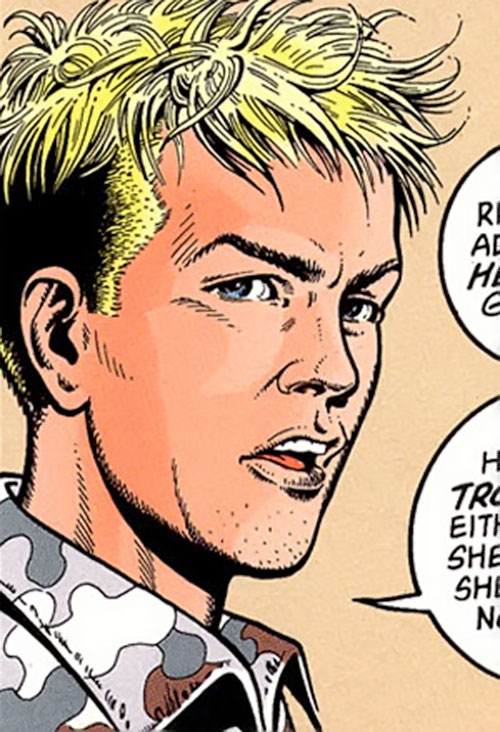
Dane McGowan is fifteen when the comic starts, from Croxteth, Liverpool. His father left when he was five. His mother stopped looking. He burns down his school library because rage is the only prayer he knows. He is, by every respectable measure, a lost cause.
The Invisibles never asks him to stop being that kid. That is the whole heresy of the book, and the reason he presides over this app. His teacher is a homeless old man called Tom O'Bedlam, who shows him the magic already inside ordinary streets, then holds him under the Mersey until the armor cracks. The armor has a name, Jack Frost: the cold thing he built inside himself so nothing could reach him. What Dane learns in the river is the thing every sitter learns eventually. Armor does not just keep pain out. It starves you.
And the armor is not his alone. The man who breaks him out, King Mob, the one with the shaved head and the guns and the coat, has built one too. His is called Gideon Stargrave, a sixties spy fantasy he can step inside when the real thing gets too close. The book is deliberate about this. The frightened boy from Croxteth and the assassin who rescues him are running the same program at different budgets. One armors with cold, one armors with cool, and neither is the person underneath. There is nobody in the story who is not wearing something. That is the most useful thing the book has to say to anyone who sits down, gets quiet, and meets the costume still running in an empty room.
And when the armor cracks, what is waiting on the other side is not punishment. It is the red circle, saying what it always says.
He also says no, and this is the part that falls out of every summary. Dane asks the obvious question, which side the Invisibles are actually on and how anybody would know, and gets no answer worth having. He is thrown back through several centuries, kills a man to stay alive, and walks out on the lot of them. He spends a good part of his own book refusing both armies. Which is fair, because the two sides turn out to be the same thing seen from different depths. Even King Mob gets there eventually and drops his gun in a pond. The practice does not require you to join anything, and the one person in the story who ends up saving the world is the one who left.
Dane turns out to be the Buddha of the coming age. He midwifes the world through its birth. And he does it without losing the accent, without becoming gentle in the fake way, without one stick of incense. His liberation is not a graduation. It is a jailbreak.
That is why he speaks here in two registers. The punk heckles you on the way out the door, because bailing on a sit deserves a laugh and not a lecture. The liberated one meets you at the milestones. They are the same person, and that is the point. The muck is not what you escape. It is what you are made of, and what the light comes up through.
On the last page of the comic, at the end of the world, Dane turns and looks straight out of the panel, at you, and passes on the only teaching he was ever given:
We made gods and jailers because we felt small and ashamed and alone.
Our sentence is up.
Every tradition that survives has one of these, and they are almost never the person you would have picked.
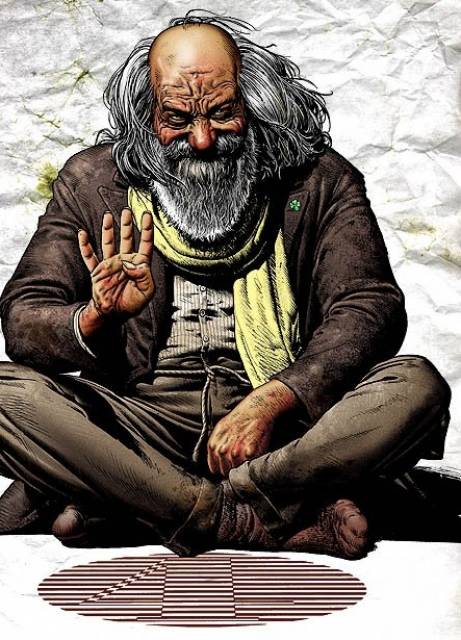
Tom O'Bedlam is an old homeless man on the streets of London. He drinks. He talks nonsense at length. He is the sort of person a city trains you to walk past. He is also the one who takes the boy in when everyone else has finished with him, and the only character in the whole book who teaches anything you could actually do on a Tuesday.
Morrison did not invent him. Tom is four hundred years old. Tom o' Bedlam is the name of an anonymous ballad from around 1620, sung in the voice of a beggar released from the Bethlem hospital, and it is the disguise Edgar puts on in King Lear after he has been stripped of his name, his inheritance and his father, and goes out onto the heath with nothing. The archetype is fixed: the man who has lost everything, who is taken for mad, and who therefore says the true thing freely because no one is listening. In the river, holding Dane under, Tom uses Edgar's own word. Flibbertigibbet. It is lifted straight out of Lear. The teacher is quoting a four hundred year old madman while he drowns his student, and the student never knows.
This is the part worth sitting with. Tom's madness is a working garment. It hides him from the enemy, it keeps the merely curious away, and it does something harder: it means nothing he gives you arrives with authority attached. You cannot take it on trust. You have to test it yourself or lose it. That is not a personality quirk. That is a pedagogy, and it is the same one behind every teacher who refuses to be impressive.
His first instruction to Dane is not a doctrine. It is a breath.
Breathe it in deep now.
And near the end of their time together he does the thing that tells you what a teacher is actually for. He puts a piece of paper into the boy's hand with an address written on it and tells him to keep it in his pocket, because when it is all done, that is where they will be waiting. He is arranging his own absence. He hands over a destination he will not walk to with him, and then he goes.
That is why he holds the door here and nothing else. The few breaths between the tap and the bell are his. He says one thing, and he is gone before the silence starts, because the silence was never his to fill.
The Invisibles contains no meditation instructions. Nobody in it sits on a cushion. There is no posture, no breathing technique, no schedule, and the character who comes nearest to being a spiritual teacher is an old drunk who talks nonsense on purpose. It is a strange well for a sitting app to draw from, and that is exactly why it works.
What the book has instead is one shape it keeps drawing, in different people, for fifteen hundred pages. The costume, the crack, the memory.
The costume. Everyone in the story is wearing one. Dane has Jack Frost, the cold thing he built at five so that nothing could reach him. King Mob has Gideon Stargrave, a spy fantasy he steps inside when the real thing gets close. There is nobody in the book who is not wearing something. Sit still for fifteen minutes with nothing to do and the first thing you meet is not peace. It is the costume, still running, defending against nothing, in an empty room.
The costume is never defeated, and the book is careful about this. Mister Six has spent most of a long life inside a persona called Mr Malcolm. When the world tears open, he does not fight it. He gathers the objects belonging to that man, throws them in as a sacrifice, and the tear seals. He beats nothing. He gives up an identity and the wound closes. That is the only move the book ever makes against a costume, and it is not a victory.
The crack. Tom's first real teaching is not a technique. Dane is kicking at pigeons in a park. Tom asks whether he would like to fly like one, and when the boy answers sarcastically, Tom puts both hands over his eyes and tells him to look. Dane comes back weeping blood. It is not information and it is not a method. It is a change of vantage, administered by covering someone's eyes. Later Tom holds him under the Mersey until the armor gives. Neither of these is gentle. Neither of them is punishment either.
The memory. This is the part that makes it a contemplative book rather than an adventure. Barbelith had already reached Dane, early, and the memory of it stayed shut until he was ready to hold it. Nothing is ever delivered to him that he did not already have. The arc is not acquisition. It is clearing enough room to remember something that has already happened to you.
Which is why the circle only ever says two things.
It's all right.
Try to remember.
Four things follow, and between them they are most of what this app believes.
Sitting is not self improvement. It is memory work, and the only entry requirement is being at the bottom of something.
Regular beats intense. Asked what anyone should actually do, Morrison compared it to a martial art or an instrument. Practise, read other people's accounts, pay attention, and details start to appear. That is the whole method.
Nothing arrives with authority attached. Tom refuses to be impressive and Morrison refuses to be believed. You test it in your own body or you lose it.
And do not join anything. Dane says no to the villains, then no to the heroes, then walks out, and the two sides turn out to be one thing in two coats. The person who ends up saving the world is the one who left.
So: a few minutes, an ordinary room, nobody watching, nothing to report afterwards. The bell goes. You sit. The bell goes again. Whatever happens in between is not this app's business and never will be.
Every meditation app has an enemy, whether it admits to one or not. It is your own inconsistency, and most of them fight it the same way: streaks that break, badges, reminders, the quietly disappointed nudge on day four. This app has an enemy too. It is not you.
In The Invisibles the enemy is called the Outer Church. It wants total control, and the book is flat about the method. It defines reality by controlling language and images, and the way it initiates a human being is to fill them with shame, fear, hopelessness and worthlessness.
That is not a supervillain's plan. It is a description of a mood. Anyone who has sat down quietly and been met by a voice listing their failures has been initiated by the Outer Church in exactly the terms the book uses.
It has a building, too. After the fire, Dane is sent to Harmony House. It is not a prison. It is a reform school whose stated purpose is to correct nonconformist behaviour, staffed by respectable people, and its methods run to lobotomy and castration.
The name is the tell. The institution that exists to break you calls itself Harmony. Calm language in the service of correcting someone is the enemy's own voice, which means an app like this one is always about two decisions away from being Harmony House with a better typeface.
So there is no streak on the screen you open, no badge, no notification, nothing that can break. Opening this after three weeks away looks exactly like opening it after thirty days in a row. A record that can shame you is not a record. It is a supervisor.
And the war is not won. Morrison does not resolve it by victory. The move is to include the enemy's desires until the enemy stops being one, and by the end the two sides are shown to be a single thing at different levels. Mister Six finishes his part of it by throwing his old identity into the tear as a sacrifice, and the wound seals.
Which leaves this app with nothing to protect you from and no intention of trying. Morrison called the comic a machine for creating Invisibles. Not a story about magicians. A device meant to do something to whoever runs it. That is the most any object can honestly claim, a book or an app: not that it will fix you, but that it is a machine, and you are the one running it.
There is a word for what Morrison thought The Invisibles was doing, and it is worth knowing even if you throw it away afterwards.
A sigil, in the tradition Morrison was working in, is a wish compressed into a mark. You take a sentence describing what you want, strip it down to a shape until the words are gone, charge it with attention, and then deliberately forget it. The forgetting is the important part. It is supposed to go to work somewhere below the level where you can interfere with it.
A hypersigil is the same idea at book length. Not a mark but a narrative, built over years, deliberately entangled with the life of the person writing it. Morrison has said outright that this is what the comic was for.
King Mob is Morrison in the book. Shaved head, coat, the lot. He was written in as part of a working on the author's own life.
Then there are the claims, and you can take them however you like. When King Mob was captured and tortured in the script, Morrison was hospitalised at that same point in the story with a collapsed lung and blood poisoning. When King Mob was written back into health and sent somewhere warm, the illness lifted, and Morrison ended up in Kathmandu, on the roof that the rest of the comic came out of.
Take the magic out and something is still left, and it is not small. What you write down about your life starts steering it. You do not need a theory for that. You reread the thing, you become a person who has read it, and you act differently afterwards. Anyone who has kept a journal for a long time already knows this and mostly does not say so out loud.
Which is why this app asks for a line after the bell, and why it then does nothing with it. It does not summarise your notes, or score them, or find patterns in them, or tell you what your practice has been like lately. It keeps them. And once a day it hands one back without being asked, from far enough ago that you had forgotten writing it.
That is the whole mechanism, and it is deliberately the smallest possible version of what the comic was doing at fifteen hundred pages. Write it. Forget it. Meet it again as a stranger.
Whether that is magic or only memory is not something this app intends to settle. Neither did the book.